
Curriculum
The Curriculum
In the primary years the school’s curriculum is planned with a view to the fact that youngsters learn best when all of their senses are used and tasks are seen to be relevant to their present and possible future lives.
The National Curriculum
The two broad aims for the school curriculum are reflected in section 351 of the Education Act 1996, which requires that all maintained schools provide a balanced and broadly based curriculum that:
-
promotes the spiritual, moral, cultural, mental and physical development of pupils at the school and of society
-
prepares pupils at the school for the opportunities, responsibilities and experiences of adult life.
The Act requires the Secretary of State, local authorities and the governing body and headteacher to take steps to achieve these requirements. The Secretary of State meets his responsibilities in this area by providing a national framework which incorporates the National Curriculum, religious education and other statutory requirements. This framework is designed to enable all schools to respond effectively to national and local priorities, to meet the individual learning needs of all pupils and to develop a distinctive character and ethos rooted in their local communities.
Early Years Foundation Stage
Children in their early years of education, in nursery and reception, are not required to work on the national curriculum, which is aimed at children in Key Stages 1 to 4. The children in Years 1 and 2 are in Key Stage 1, the children in Years 3, 4, 5, and 6 are in Key Stage 2. The children in Reception and Nursery are in the Foundation Stage, which includes all children from 3 to 5 years from starting in nursery to the end of the reception class.
The guidance on teaching this age of children is entitled ‘The Early Years Foundation Stage’. This sets out specific goals and targets, which the children are expected to achieve. The aim is to enable young children to learn in a less formal way through play and experimentation as well as direct teaching. When the children have achieved these goals they will move onto the National Curriculum.
Dubmire Primary School Curriculum
This school seeks to provide all pupils with a broad, balanced and relevant curriculum matched to their individual needs.
The children in the Foundation Stage are provided with learning experiences to build on what parents will already have achieved, and to establish a foundation for the national curriculum. Teaching in early years covers all aspects of the curriculum of the school but in a way that is appropriate to the needs of very young children.
Every Key Stage 1 and 2 child will be taught the National Curriculum according to its programmes of study as they are introduced. Religious Education will also be taught to the children.
Whilst the National Curriculum is being taught throughout this school, the subjects may or may not be taught as separate items.
During the course of the year all pupils will cover the full range of subjects within the National Curriculum, though at different stages of the year there may be a different emphasis (and therefore time) allocated to each curriculum area or an aspect of it. Children will also have the opportunity to improve their knowledge of Health Education and develop their personal and social skills as an integral part of their studies throughout the year. The National Curriculum (and the accompanying assessment) as delivered in this school is a legal requirement and, ordinarily, no pupil may be excused.
We present the curriculum in an imaginative and stimulating way so as to capture children’s enthusiasm, and provide them with a firm base of knowledge, skills and positive attitudes to learning. At times your child may be with a teacher on a one-to-one basis, or in a group whose needs are similar at that time. At other times your child may be taught in a larger group or a whole class.
English
Y1-6 follow the National Primary Strategy. Through this and other opportunities to develop English teaching we provide for the development of reading, writing, speaking and listening. We aim to make reading an enjoyable experience and do this by reading from a wide variety of books and other reading material. This is done in small groups and with large texts with the whole class reading together. Children experience material at different levels of complexity so that they become fluent and competent readers. Writing is also taught in small groups and as a whole class sharing a writing experience together. Spelling strategies are taught to foster confidence and competence in writing. We encourage the children to talk and express themselves well so that they become confident with spoken language. We place great emphasis on the ability to listen, speak in different situations, work collaboratively in groups and express themselves through drama.
Mathematics
The National Primary Strategy is taught in Y1-6. The strategy lays great emphasis on developing the children’s mental abilities to solve mathematical problems. We will continue to stimulate the children by giving them a lively sense of interest and pleasure in Mathematics and its use in everyday life. We stress the thorough understanding of mathematical ideas and then we apply these ideas to new situations. The children are given opportunities and experiences to develop knowledge and understanding of the four basic functions of number, measures, shape and space and data handling and problem solving.
Information and Communication Technology
Pupils are taught skills and knowledge to equip them in the ever increasing field of technology. Children are encouraged to apply their skills to support individual learning and enquiry. ICT will be used to support and enhance all curriculum areas.
Science/ Design Technology
Children are involved in practical investigations which build on their own interests and experience. Individual and group skills of planning, decision-making, investigating and communicating results, as well as observing, classifying, recording, making and testing hypotheses, designing experiments and drawing information from evidence are vital to science-based activities but also have a much wider application.
We aim to give children the confidence to identify, examine and solve practical problems to enable pupils to feel competent in a technological world. Through DT they are encouraged to think creatively, to develop their knowledge, skills and understanding with a specific purpose in mind.
History
We introduce children to historical personalities, and events, through stories, poetry, pictures, TV, radio and festivals at a local, national and world level. We use the children’s own lives and environment to make them aware of the passage of time.
Geography
We introduce children to the local area as well as extending their factual knowledge. This is done using maps, photographs, written accounts and other sources. All children study areas beyond their locality.
Art and Design
We encourage the children to experience a variety of different techniques as well as the work of other artists. They are also encouraged to plan, manipulate different materials, and evaluate their work.
Religious Education
The religious education curriculum is taken from Sunderland’s Agreed Syllabus, which has been discussed, agreed and ratified by the city of Sunderland’s Education Committee, local teachers, and representatives of all major faiths and denomination. Although Christian-based, it also ensures that our pupils gain respect, awareness and understanding of other world religions. There are varied arrangements for daily worship, including class and whole-school assemblies.
All parents have the right to withdraw their child from the school’s daily act of collective worship, and/or religious education. If you would like to withdraw your child from these parts of school life please write to the Head Teacher.
Personal, Social, Health Education and Citizenship
The children will be given various opportunities to develop appropriate personal and social skills to enable them to become caring and contributory members of society. They will also be encouraged to develop the habits of a healthy lifestyle. Care for our own community is paramount. The school has achieved Healthy School Status and we have achieved the prestigious Green Flag Award by July 2010. We have reached Foundation level of the International School Award and hope to achieve the Intermediate level by July 2012.
Music
All children participate in class music making. They are encouraged to, enjoy singing, listen to music, and create their own. Children with a particular interest may receive individual tuition in violin, clarinet, flute, saxophone, cornet and guitar. Furthers information is available from the school office.
Physical Education
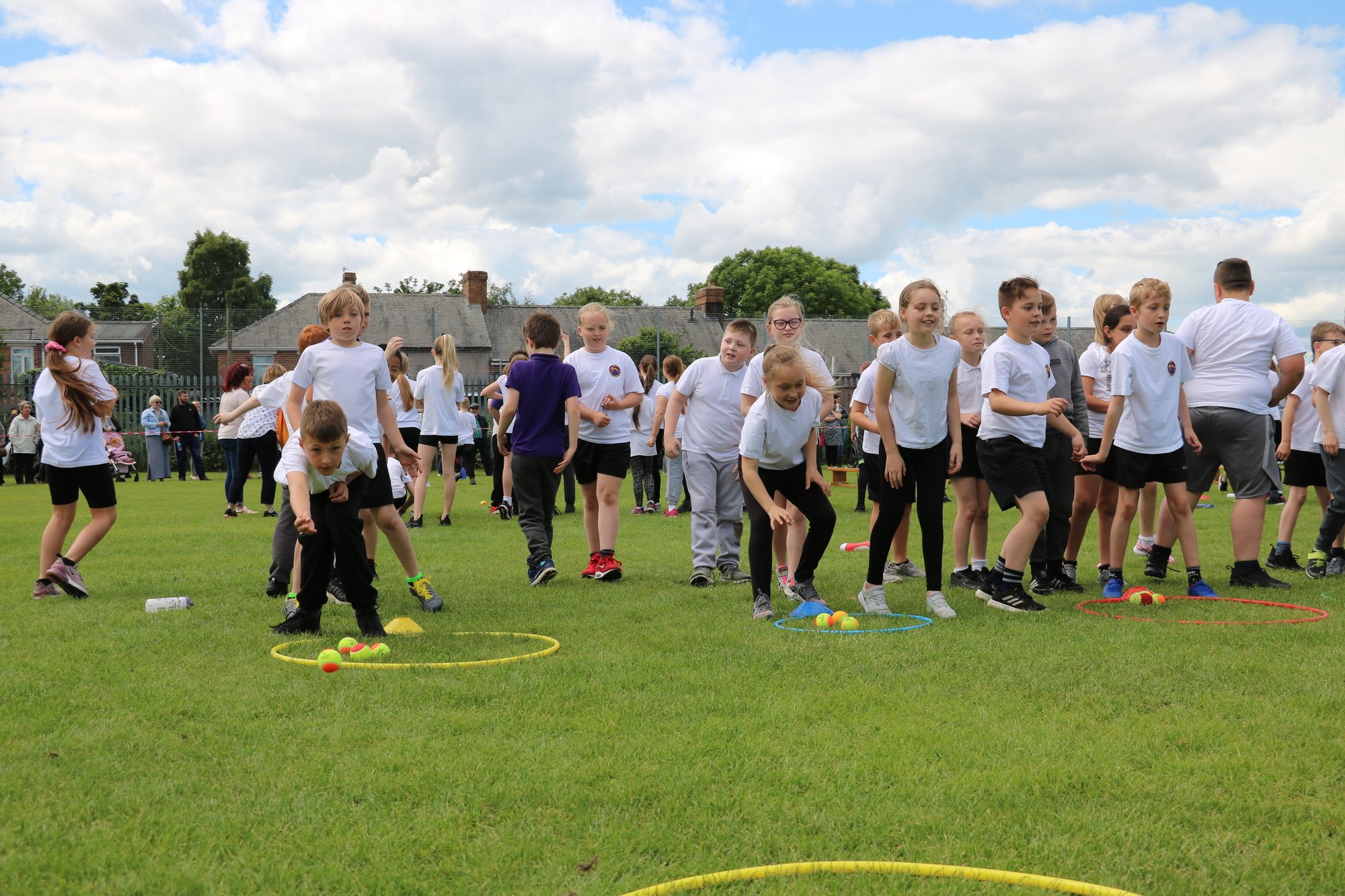
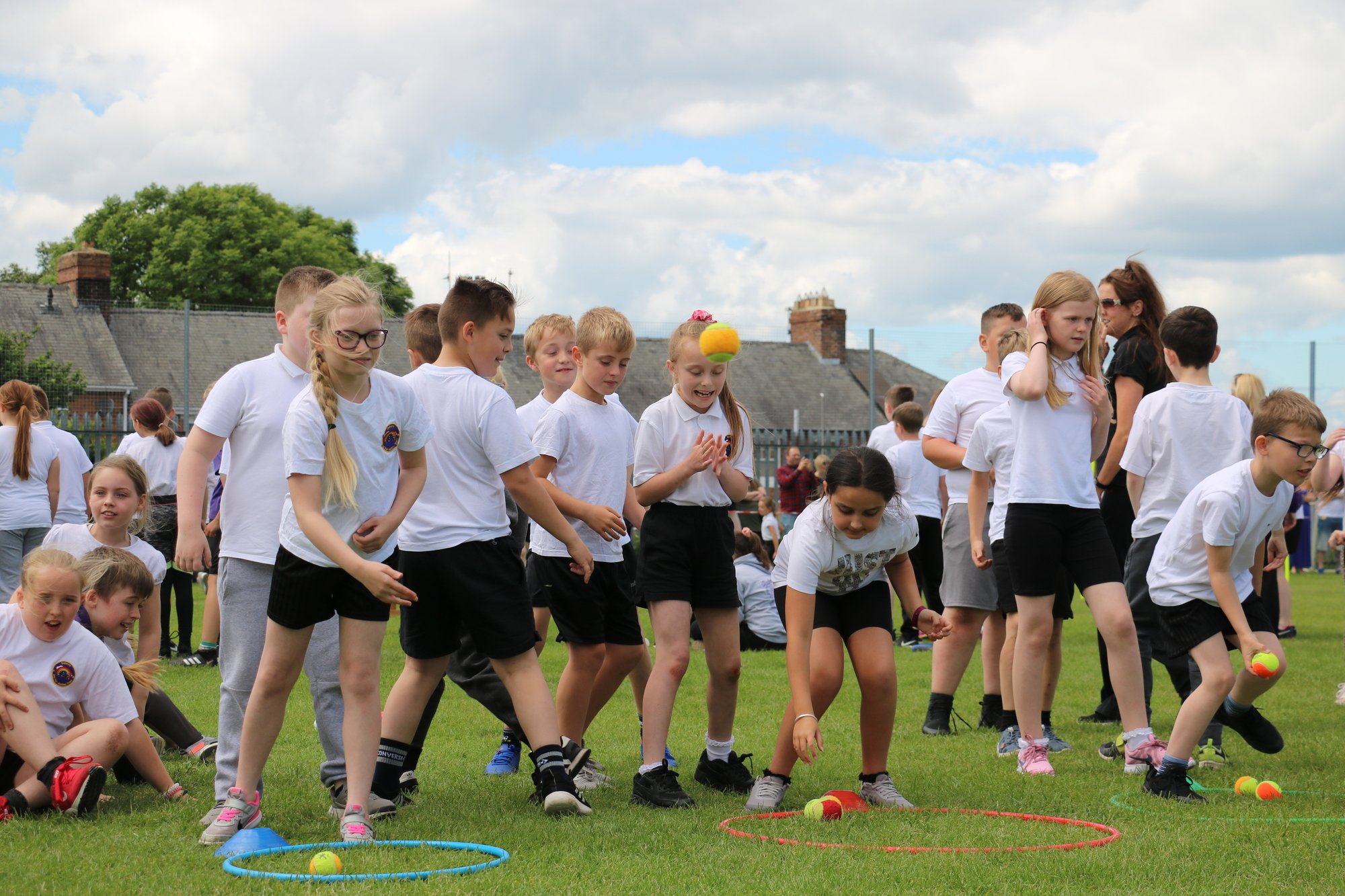
We endeavour through Physical Education to provide the children with the opportunity to develop agility, co-ordination of mind and body together with posture and development and the ability to express feelings through Movement, Dance, Gymnastics and Games. Social skills, i.e. group work and team work are developed in school and outdoor activities.
Sporting Aims and Provision
We have football and netball teams for children in school.
The formal school curriculum is not used to practise full sided team games - the emphasis is on small sided games that ensure much activity by all participants. Match skills are an important element.
During the football, netball and cricket season regular match practice will take place. The school is in the local school leagues and takes part in cup competitions.
The new facilities provide us with an enhanced multi-use hall, floodlit multi-use games area,
hard court areas, football pitch and internal and changing facilities with showers. As the facilities develop so will the range of sporting activities on offer to all the children and members of the community.
Children are encouraged to join some of the many sporting activities organised by external agencies or individuals, including parents.
Sex Education
The content of our sex education teaching has been drawn up in accordance with Sunderland City Council’s guidelines and has been approved by the School Governors. Sex education is part of our personal, social and health education policies. We aim to create a climate in which children feel able to ask questions and to have them answered in a frank yet sensitive and appropriate manner.
Sex and Relationships Policies
Educational Visits
As part of the curriculum groups of children may be taken off site on educational visits. Each visit is carefully prepared, risk assessed and followed up so that the maximum benefit may be derived from them. Parents will be advised via the school web site calender of the visit, and will have already given consent by signing the school data pack for their children to leave the site.
Only residential visits and those with any additional risks will require further written consent from parents, for example the trip to Derwent Hill or the year 6 visit to Lightwater Valley.
By law no state school can make a charge for any education which takes part wholly within the school day or for visits that are necessary as part of a childs education. Notwithstanding this, schools are permitted to ask parents for contributions towards transport costs and to excursions where the third party charges the school for its services. The Governing Body has agreed to subsidise all educational visits, however we do on occasions need to request parental contributions as without these, the cost of many of trips would be prohibitive.